





 Contact
Can you imagine a time where you couldn’t edit your website with an internet browser?
In August 1995, Viaweb was already taking shape as the first web application: an eCommerce software-as-a-service (SaaS) platform. The concept of a web application itself was innovative and revolutionary, and it’s no surprise that eCommerce was the first use-case pushing that innovation.
Around the same time Viaweb was taking shape, a quirky, fun company called Yahoo had raised $5 million in series B funding and was quickly positioning itself as the leading portal to the internet for millions of newcomers. Yahoo acquired Viaweb in 1998, rebranding it as “Yahoo Store.” They combined this unique and novel eCommerce platform with Yahoo Shopping, a search portal which listed Yahoo Store products and directed consumers to purchase within the ecosystem. The Yahoo Store base grew as more entrepreneurs saw cyberspace as an increasingly profitable environment, and Yahoo was the place to grow online.

Yahoo Store utilized a revenue-share mode, intended to scale billing with the merchant’s growth. At the time, there was a partnership between merchants and the platform because both parties needed each other to thrive. Yahoo Store would provide an innovative web application with agile improvements. Yahoo Shopping would index those items and drive traffic and sales for Yahoo Store owners. In return, Yahoo merchants would pay a flat percentage of their sales.
In 2001, the dot-com bubble burst. Yahoo shares declined from an all-time high of $118 a share in 2000 to $8 a share in 2001. The company began acquiring advertising services, while improving their core products at a steady pace. According to merchants, Yahoo Store and Yahoo Shopping received less attention during this period, with Yahoo Shopping inclusion soon dropped as an automatic value proposition for platformed merchants. Yahoo continued charging merchants a percentage of their sales, and a monthly fee, while decreasing their investment in the platform and merchant success.
This innovation vacuum and increasing demand from aspiring merchants paved the way for Shopify in 2006, Magento in 2007, and BigCommerce in 2009. Yahoo Store would need to develop new features quickly to keep up, and the investment required was never prioritized.

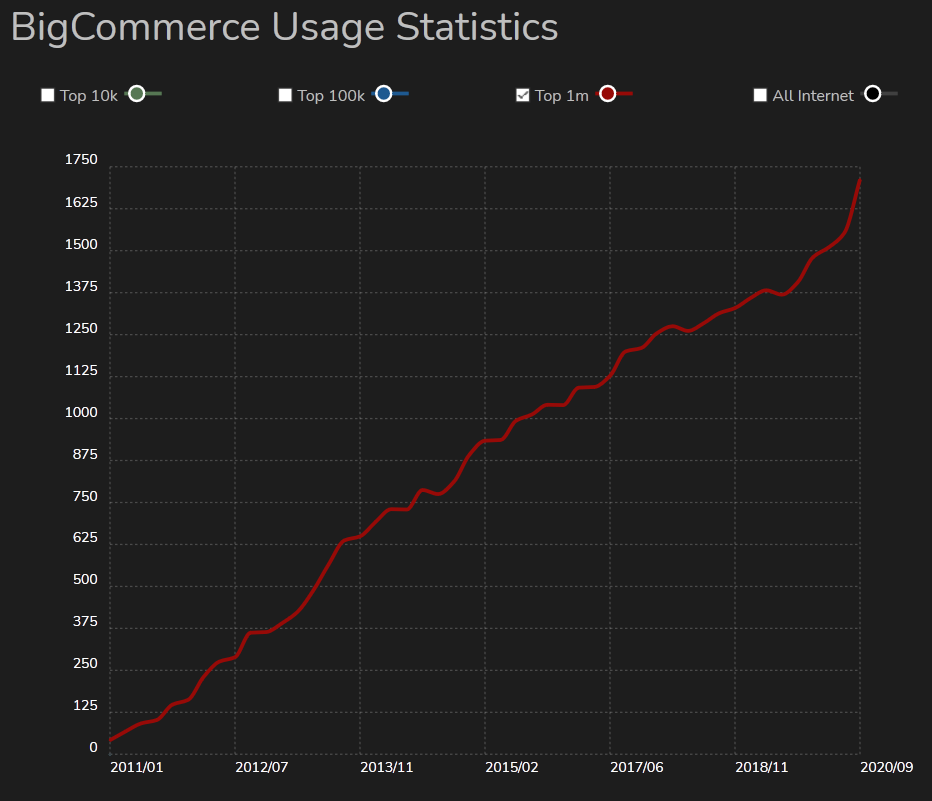
- From BuiltWith, quantity of websites per platform in the top 1 million trafficked sites over time
In 2014, the legacy Yahoo Store platform was already a hard sell for merchants with integration requirements. In an attempt to modernize, Yahoo launched a new SaaS platform for eCommerce, also called “Stores” (not to be confused with the then 16-year-old Yahoo Store). The new platform attempted to create a simplified path for startups to start selling online. It launched amid a sea of competitors. Signs point to that plan falling through as that platform appears to be no longer available.
In 2015, when Yahoo searched their portfolio for a product to spin off into its own holding company for valuable Alibaba shares, it chose Yahoo Small Business. This business, including Yahoo Store, was called “legacy” and “ancillary” by then-CEO Marissa Meyer. She acknowledged that eCommerce platforms are hard to scale. Moving Yahoo Small Business out of the company wouldn’t impact their ongoing focus on core products like advertising solutions. This move would have made Yahoo Store the required business front for a “SpinCo” investment company, goaled with returning Alibaba share value to its shareholders. It’s unclear what would have happened to Yahoo Store and its merchants after those shares were sold off in 2019 and SpinCo closed down shop. Fortunately (or not), Yahoo canceled plans to include Yahoo Small Business as a whole with the spinoff.
As of 2016, it had been about 8 years since the platform had seen significant development. Verizon announced it would buy Yahoo and acquire its products, Yahoo Store included. Yahoo Small Business (by then rebranded as Aabaco Small Business) was included with AOL and other assets under a new Verizon brand: Oath. This was a lot of proper nouns for merchants to learn in a relatively short amount of time, uncertain when the dust would settle and what this would all mean for the evolution they needed to see in their eCommerce platform.

It has been five years since Yahoo Store was called “legacy and ancillary” by Yahoo’s CEO, and the diminished investment is clear. Recent events like the COVID pandemic and the ongoing increase in eCommerce consumer confidence has led to an explosion of new online businesses and continually broken global sales records. BigCommerce aimed to provide more features and functionality out of the box, while investing in developer and app ecosystems for advanced customization. Today, a merchant selling online is limited only by budget, imagination, and their eCommerce platform. Yahoo Store merchants continue to weigh the cost of migration and staying until their hands are forced. The pool of trusted developers for Yahoo’s proprietary and complex RTML programming language is small and shrinking.
Many popular eCommerce solutions force merchants to pay research and development costs to integrate with Yahoo, whereas native apps exist with leading eCommerce platforms. The Yahoo app store has about 30 options, where BigCommerce has over 800. Disregarding apps, BigCommerce has a lot more features baked in than Yahoo Store. For example, a modern customer registration system with customer groups and pricing, wishlists, and a store credit system is native to BigCommerce. Amazon Pay, Apple Pay, Authorize.net, and many more options are available out of the box for payment processing options. Avalara’s AvaTax and Quickbooks are among other solutions integrated directly with BigCommerce’s control panel.
eCommerce thrives today because successful platforms never stop adding the features and functionality their consumers need to be successful. Each caters to merchants with slightly different needs. That’s why companies like EYStudios are able to assist your business in navigating to the right platform. Our team can help you to grow and shape your business on the eCommerce landscape for years to come.
Ready to get started? Give us a call today to set up an eCommerce consultation.
